We Analyzed Every Hot Ones Sauce. Here's What 29 Seasons Taught Us About Heat vs Flavor.
Everyone knows Hot Ones gets hotter as you go. That’s the whole point. Sean Evans lines up ten sauces from mild to murderous, and guests either power through or tap out somewhere around wing seven. Good TV. But here’s the thing we kept coming back to after scoring all 290 sauces across 29 seasons: does “hotter” actually mean “less flavorful”? Is there a point where heat just bulldozes everything else? We ran the numbers to find out.
The Climb Is Real (and Exponential)
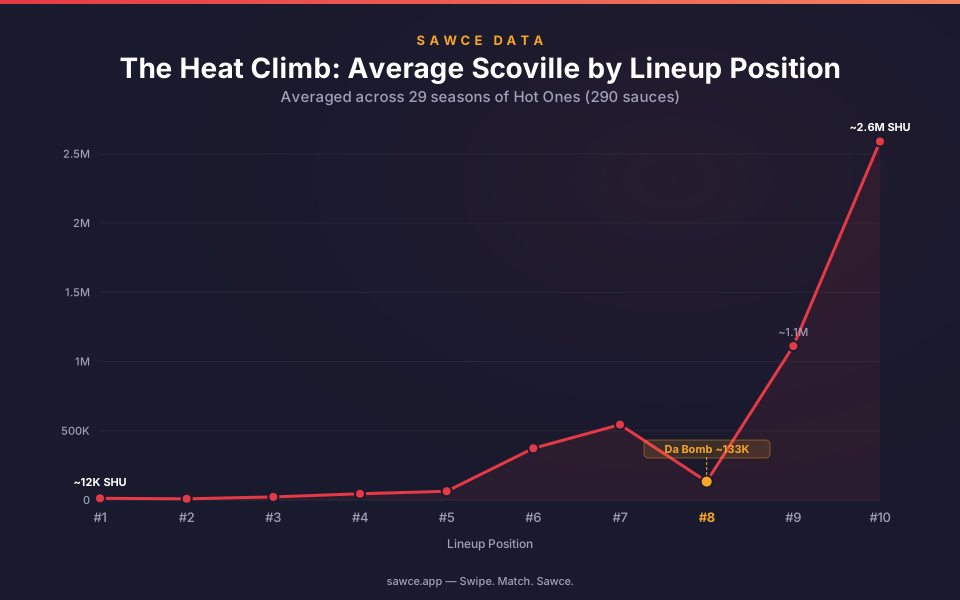
The average Scoville rating at position #1 hovers around 12,000 SHU. Comfortable. A warm handshake. By position #5 you’re at about 63,000 SHU, which is solidly in habanero territory. Then it gets wild. Position #7 averages over 544,000 SHU, position #9 crosses the million mark at 1.1M, and position #10 lands around 2.6 million SHU. That’s not a steady climb. It’s more like hiking uphill for a while and then stepping off a cliff.
But notice that weird dip at position #8. The average Scoville there is only about 133,000 SHU, which is lower than positions #6 and #7. That’s not a data error. That’s Da Bomb.
The Da Bomb Problem
Da Bomb Beyond Insanity has sat in the #8 slot for 28 of 29 seasons. It’s the most consistent fixture in the entire show. And on paper, 135,600 SHU doesn’t even crack the top five hottest positions. So why does it destroy people?
Because Da Bomb is an extract-based sauce. It uses concentrated capsaicin to deliver heat without the buffering that whole peppers provide. There’s no fruity habanero sweetness to ease the burn, no smoky chipotle complexity to give your brain something else to focus on. It just hits. The Scoville number tells you the heat level, but it doesn’t tell you what kind of heat you’re getting. Da Bomb delivers the purest, least cushioned burn in the lineup.
When we scored it across ten flavor dimensions, the contrast was pretty striking.
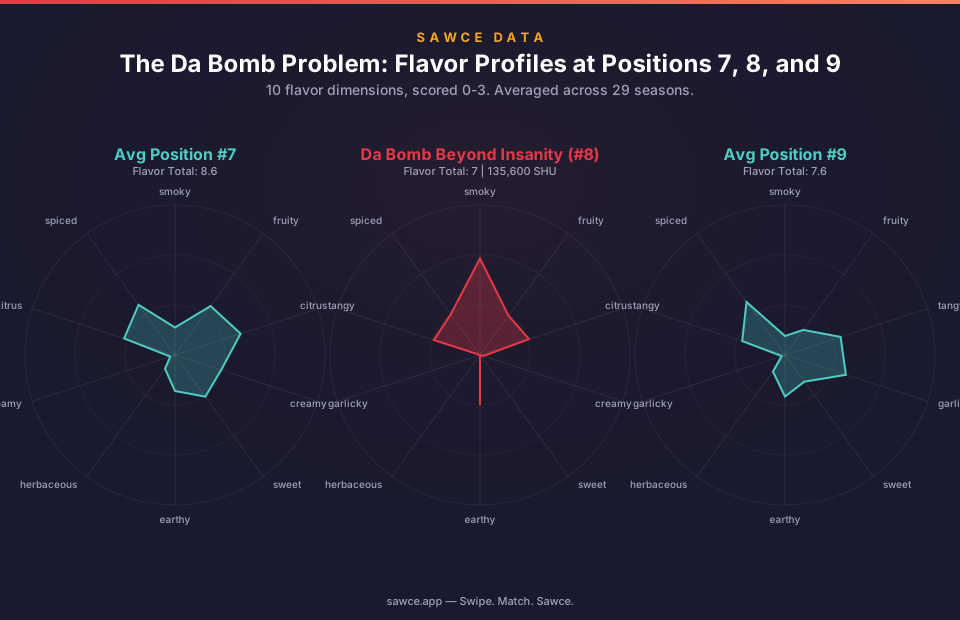
Look at the shapes. The average sauce at position #7 has a nice spread across fruity, tangy, sweet, citrus, and spiced. Decent complexity. The average sauce at position #9 shows strong garlicky and spiced notes, with tangy and citrus filling things out. Both of those are real, multidimensional flavor profiles. Then look at Da Bomb in the center. Heavy on smoky (from the extract character), a bit of tangy and citrus, and then basically nothing for garlicky, sweet, herbaceous, or creamy. The polygon practically collapses. It’s not a flavor profile. It’s a heat delivery device.
That’s why guests who handle #7 just fine suddenly look like they’re reconsidering their life choices at #8, even though #7 is technically hotter by Scoville rating. The flavor dimensions that normally distract your palate and help you process the burn just aren’t there.
The Curve Breakers
Here’s where it gets interesting. Not every sauce at the top of the lineup follows the “more heat, less flavor” pattern. Some sauces are genuinely complex and brutally hot. We tagged these as “curve breakers” in our dataset, and they’re some of the most impressive bottles in the entire show’s history.
Torchbearer Garlic Reaper (Season 8, position #7) pairs Carolina Reaper heat with a massive garlic backbone. It scores a 10 across our flavor dimensions while packing 1,000,000 SHU. The garlic doesn’t just coexist with the heat. It makes the heat feel intentional, like a choice rather than a punishment.
Burns & McCoy Exhorresco 7-Pot Primo (Season 7, position #9) sits at 750,000 SHU with a flavor total of 9. For a sauce that deep into the lineup, it has no business being that well-rounded.
Queen Majesty Cocoa Ghost (Season 17, position #6) uses chocolate and ghost pepper to create something that reads more like a mole than a challenge sauce. 150,000 SHU with a flavor score of 12. That’s one of the highest totals in the dataset, period.
Karma Sauce Cosmic Disco (Season 19, position #7) hits 300,000 SHU with a perfect 12 on flavor total. Fruity, tangy, and complex in a way that makes you forget you’re being hurt.
These sauces prove that heat and flavor don’t have to be inversely related. The makers just have to care about both.
Season Superlatives
Twenty-nine seasons is a lot of data. Here are the standouts when you slice it by season.
Most Flavorful Season: Season 18. Averaging 9.8/30 across all ten positions, S18 featured Adoboloco’s Island Wings, Burns & McCoy’s Mezcaline (one of the highest flavor scores in the entire dataset at 15/30), Sauce Leopard’s Seventh Reaper, and Halogi’s Tyrfing’s Curse. A lineup that proved you can push heat without abandoning taste.
Hottest Season (Total Combined SHU): Season 12. Add up all ten sauces and S12 clocked over 7.1 million total SHU. That lineup included Volcanic Peppers’ Thor’s Hammer, SeaFire Gourmet’s Reaper, and Chile Monoloco’s MataSanos. Guests did not have a good time.
Mildest Season: Season 1. The O.G. lineup totaled about 1.7 million combined SHU. Texas Pete, Cholula, El Yucateco. Back when the show was still figuring out how far it could push people.
Most Pepper Varieties: Season 22. Twelve different pepper types showed up across one lineup, from shishito and jalapeno at the mild end to 7-Pot and Pepper X at the top. The widest pepper vocabulary of any season.
Most Flavor-Diverse: Season 28. Eight different dominant flavor dimensions across ten sauces. No two sauces led with the same note. Dawson’s Coffee Date (earthy), Savir’s Crema Macha (creamy), Hawaiian Hot T’s P.O.G.² (fruity), and Karma’s Funken Hot Yellow Moruga (spiced) all brought something completely different to the table.
Most International: Season 28 (tied). Four different countries represented in one lineup. Hot sauce is a global language.
Highest Individual Flavor Score: Curry Verde by La Pimenterie (S21). 16/30. That’s more than double the dataset average. A Thai-inspired green curry sauce that maxed out on herbaceous, spiced, and citrus while sitting at position #2. Proof that the mild end of the lineup often hides the most interesting bottles.
Lowest Individual Flavor Score: PAIN 100% by Pain Is Good (S1, S2). 3/30. An extract-heavy sauce from the show’s early days that makes Da Bomb look nuanced by comparison.
The Wall of Shame
Only 17 guests out of 300+ episodes have tapped out before reaching the final wing. A 95% completion rate. But the pattern of where they quit tells you everything about what we just covered.
| Guest | Season | Quit At | The Sauce That Did It |
|---|---|---|---|
| DJ Khaled | S1 | Wing 3 | El Yucateco Caribbean Habanero |
| Tony Yayo | S1 | Before wing 10 | Unknown |
| Eddie Huang | S2 | Wing 2 | Tapatio Salsa Picante |
| Mike Epps | S2 | Wing 6 | PAIN 100% |
| Jim Gaffigan | S2 | Wing 8 | Da Bomb Beyond Insanity |
| Rob Corddry | S2 | Wing 8 | Da Bomb Beyond Insanity |
| Ricky Gervais | S3 | Wing 8 | Da Bomb Beyond Insanity |
| Mario Batali | S4 | Wing 8 | Da Bomb Beyond Insanity |
| Taraji P. Henson | S5 | Wing 6 | Had her bodyguard finish for her |
| Lil Yachty | S7 | Wing 8 | Da Bomb Beyond Insanity |
| Shaq | S8 | Wing 8 | Da Bomb Beyond Insanity |
| Chance the Rapper | S10 | Wing 8 | Da Bomb Beyond Insanity |
| Eric Andre | S12 | Wing 8 | Da Bomb Beyond Insanity |
| Quavo | S15 | Wing 8 | Da Bomb Beyond Insanity |
| Pusha T | S17 | Wing 8 | Da Bomb Beyond Insanity |
| Ice Spice | S23 | Wing 8 | Da Bomb Beyond Insanity |
| Bad Bunny | S26 | Wing 8 | Da Bomb Beyond Insanity |
Eleven of seventeen tap-outs happened at wing 8. Da Bomb. The extract-based sauce with the lowest flavor score in the lineup. It’s not the hottest sauce on the table by a long shot (positions 9 and 10 are both significantly higher in Scoville), but it’s the one with nothing to hold onto. No fruity sweetness, no garlic depth, no tangy bite. Just pure capsaicin pain with nowhere to hide.
DJ Khaled remains in a class of his own. Three wings. Then he looked Sean in the eye and said, “I’m not a quitter. I just know when to stop.” That’s still the most quoted line in the show’s history for all the wrong reasons.
The Last Dab Hall of Fame
At the other end of the spectrum, some guests treated the final wing like a dare they were born to accept. The “Last Dab” is the show’s closing ritual: guests add extra sauce to wing 10 and answer one final question. Most guests add a polite drop. These people did not.
Lil Nas X (S13) holds the official record for the biggest Last Dab in show history. He poured roughly a quarter to half a bottle of The Last Dab Apollo (2+ million SHU) onto his final wing. Sean Evans visibly reacted in a way he almost never does. The episode title says it all: “Lil Nas X Celebrates Thanksgiving With the Biggest Last Dab Ever.”
Paul Rudd (S10) didn’t just dab. He mixed all ten sauces together into a puddle and dipped his final wing into the combined slurry. Then delivered the line that became one of the show’s most iconic memes: “Hey. Look at us. Who would’ve thought? Not me.” The episode sits at 8.6 on IMDb.
Shaq (S8) attempted the same all-sauces-combined move as Rudd, though he’d technically already tapped out at Da Bomb. Points for ambition.
The Last Dab ritual works because it’s voluntary escalation. Nobody makes you add extra sauce. The fact that guests do it anyway, with their mouths already destroyed, says something about what 30 minutes of shared suffering and increasingly honest conversation does to a person. By wing 10 you’re not performing anymore. You’re just in it.
The Full Picture
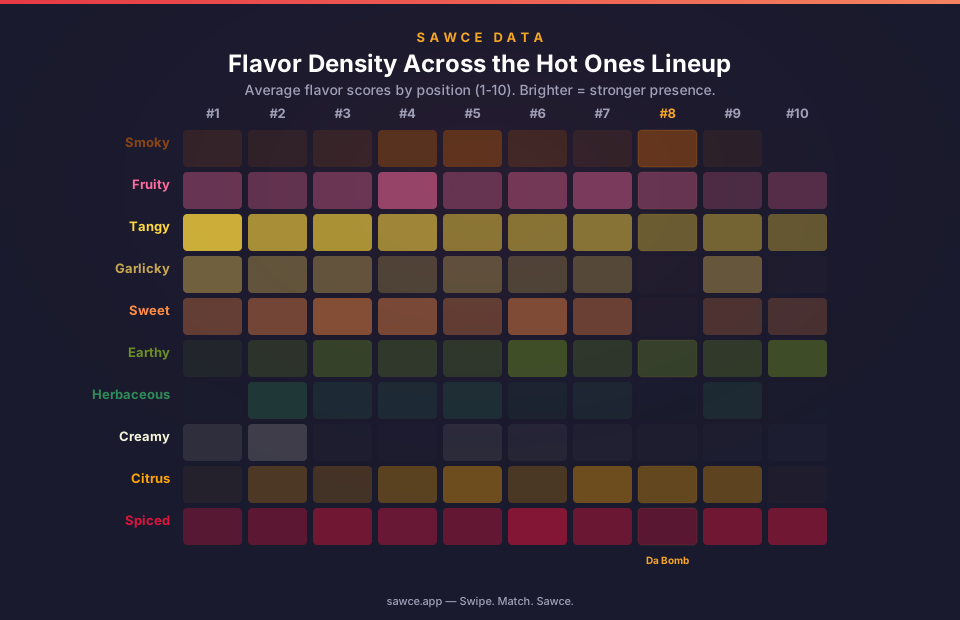
This heatmap shows average flavor intensity for each dimension across all ten positions. A few patterns jump out.
Tangy dominates the early lineup. Positions #1 through #3 are the tangiest part of the show, averaging scores above 1.8. That’s the vinegar-forward, Louisiana-style sauces doing their thing. As you climb higher, tang fades. The late lineup leans more on earthy and spiced notes to carry whatever flavor exists alongside the heat.
The #8 column is a ghost town. Zero sweetness, zero herbaceous, zero creamy, nearly zero garlicky. The Da Bomb effect isn’t just visible in the radar chart. It shows up here as a dark stripe running down column eight. It’s the emptiest position in the lineup by a wide margin.
Positions #4 and #5 are the sweet spot (literally and figuratively). They have the best balance of flavor diversity, with solid scores across smoky, fruity, tangy, sweet, and citrus. This is where the show’s producers tend to slot the most interesting mid-range sauces, and the data backs that up.
Position #10 narrows hard. By the finale, you’re mostly getting earthy and spiced notes, with almost everything else dropping to near zero. At 2.6 million SHU, there’s only so much flavor real estate left.
Seven Things the Data Taught Us
We ran every correlation and regression we could think of against 192 unique sauces. Some confirmed what we expected. Others completely surprised us.
The real flavor cliff is at #10, not #8
This one busted our own assumption. Flavor complexity actually holds steady from positions 1 through 7, ranging between 8.0 and 10.1 out of 30. It dips at #8 (7.0, the Da Bomb effect), recovers at #9 (7.6), then falls off a cliff at #10 with a 2.6-point drop. The Last Dab variants are the real flavor graveyard. Da Bomb just gets all the attention because it’s the only dip flanked by recovery on both sides.
Two peppers are better than one
Sauces built around two primary peppers average a 10.0 flavor score versus 8.6 for single-pepper sauces. But three or more peppers drops back to 8.0. Those tend to be superhot blends where the peppers are all there for heat, not contrast. The sweet spot is two complementary peppers playing off each other.
Habanero is popular, not optimal
We ranked every pepper by its flavor-to-heat ratio. Jalapeno leads at 3.67, followed by chipotle (2.13) and Scotch Bonnet (1.85). Habanero comes in at 1.71. It dominates by volume (42 sauces in the dataset) but Scotch Bonnet delivers more flavor per unit of heat. At the bottom: Pepper X at 0.64. All heat, minimal flavor payoff.
More ingredients = more flavor (r=0.61)
This is the strongest correlation in the entire dataset. Sauces with 13-20 ingredients average an 11.0 flavor score. Sauces with 1-5 ingredients average 5.8. It makes intuitive sense. More ingredients means more dimensions to score on. A two-ingredient sauce (pepper + vinegar) can only hit tangy and spiced. A sauce with stone fruit, roasted garlic, smoked peppers, and herbs can fill out half the radar chart.
Geography shapes flavor
Louisiana sauces are pure tang (3.0 tangy, nearly nothing else). Texas leans earthy and spiced. California is the garlic capital. Quebec quietly produces the most flavorful sauces in the dataset at 10.1 average. Tennessee, with a small sample, leads at 10.5. Where a sauce comes from tells you more about its flavor than its price tag.
The “palette cleanser” hypothesis is wrong
We expected positions #4 and #5 to show unusually high flavor diversity, like the producers were giving guests a reset before the second half. Nope. Positions #2 and #6 actually have the most even flavor distribution. The mid-lineup isn’t a calculated breather. It’s just where heat starts escalating. The real outlier is #8, with only two dominant flavors across all 29 seasons. Because it’s Da Bomb every time.
Price buys heat, not flavor
No meaningful correlation between price and flavor complexity (r=-0.10). But there IS a strong correlation between price and heat (r=0.57). The $10-13 range has the best average flavor at 9.4. Above $16, flavor drops to 6.6 while heat spikes to 9.5. You’re literally paying for pain, not taste.
Flavor Saves: The Survival Data
We cross-referenced our flavor data with guest completion records from 300 Hot Ones episodes (seasons 1-21). Only 15 guests out of 300 failed to finish. A 95% completion rate. But the distribution isn’t random.
Season 1 had a 25% failure rate. By seasons 18-21, it dropped to zero. You might assume guests got tougher or the show got easier. Neither is quite right. What changed was the quality of the lineup.
When we compared each season’s average flavor score to its failure rate, a clear pattern showed up. Seasons with tastier lineups had fewer guests tapping out. Not by a little. The relationship is strong enough to be statistically meaningful (r=-0.47 for the stats-minded folks). Meanwhile, how hot the season was barely mattered at all (r=-0.07). You could crank the Scoville numbers up or down and it didn’t predict whether guests would finish.
Put simply: flavor helps you survive heat. When a sauce has garlic depth, fruity sweetness, or tangy bite alongside the burn, your brain has something else to chew on. You taste mango. You notice smoke. You think “oh, that’s interesting” instead of just “oh god, make it stop.” When the sauce is nothing but raw capsaicin (Da Bomb, we’re looking at you), there’s no distraction. The pain gets 100% of your attention, and that’s when people quit.
Think of it like running on a treadmill. With music or a good podcast, you can push through discomfort because your brain is partly elsewhere. In silence, every second of effort is front and center. Flavor is the music. Extract-based heat is the silent treadmill.
Published research backs this up. Capsaicin triggers your brain to release endorphins as a pain counter, and studies show that the resulting pain still degrades your ability to think clearly and manage discomfort. Flavor complexity appears to act as a second sensory channel, giving your brain something productive to do with the incoming signals instead of just panicking.
Why Sean Asks the Hard Questions at Wing #8
This one isn’t in our dataset. It’s in the peer-reviewed literature and Sean’s own interviews.
Sean Evans has confirmed in multiple interviews that he saves his most personal, most probing questions for the back half of the lineup. His team researches each guest exhaustively, finding topics they’ve deflected in other interviews or only partially explored. Those questions land at positions 7-9.
The science explains why this works so well. By wing #8, guests are dealing with:
- Acute capsaicin pain activating TRPV1 receptors
- Endorphin flooding as the brain’s opioid counter-response
- Degraded executive function from pain-induced cognitive load (PubMed)
- The Da Bomb double-whammy: extract heat with zero flavor buffer
The prefrontal cortex, the part of your brain that maintains your rehearsed media persona and decides what not to say on camera, is under siege. And that’s exactly when Sean drops the question about your relationship with your father or what really happened on that movie set.
No one has published a direct study on capsaicin and social disinhibition (someone should). But each link in the chain is independently peer-reviewed. Capsaicin causes pain. Pain degrades executive function. Reduced executive function means reduced inhibition. Sean weaponizes this every episode. It’s brilliant interview design disguised as a wing-eating contest.
Guests Are Getting Tougher (or Smarter)
One more finding from the episode data. Early seasons (1-7) averaged a 9% failure rate. Late seasons (15-21) averaged 2%. Guests are either genuinely tougher or they’re doing their homework. Some combination of the show’s fame (guests arrive prepared) and improved lineup curation (more flavorful sauces cushioning the heat) has made the gauntlet more survivable. Whether that’s good or bad for the show depends on whether you watch for the interviews or the meltdowns.
What This Means for How We Think About Sauce
This data reinforced something we’ve believed for a while at Sawce: the Scoville scale is a useful number, but it’s a terrible way to choose a sauce. A 500,000 SHU sauce made with real scorpion peppers, roasted garlic, and stone fruit is a completely different experience than a 135,000 SHU extract sauce. The number alone doesn’t capture what’s happening in the bottle.
That’s why we built our flavor profiles around ten separate dimensions instead of a single heat rating. When you’re swiping through sauces in Sawce, you’re not just seeing “how hot.” You’re seeing the full shape of the flavor, the same way we visualized it in those radar charts above. Because the best hot sauces aren’t the ones that hurt the most. They’re the ones that make you reach for the bottle again.
Want to explore the full dataset? Check out the interactive Flavor Gauntlet where you can dig into every sauce across all 29 seasons.